


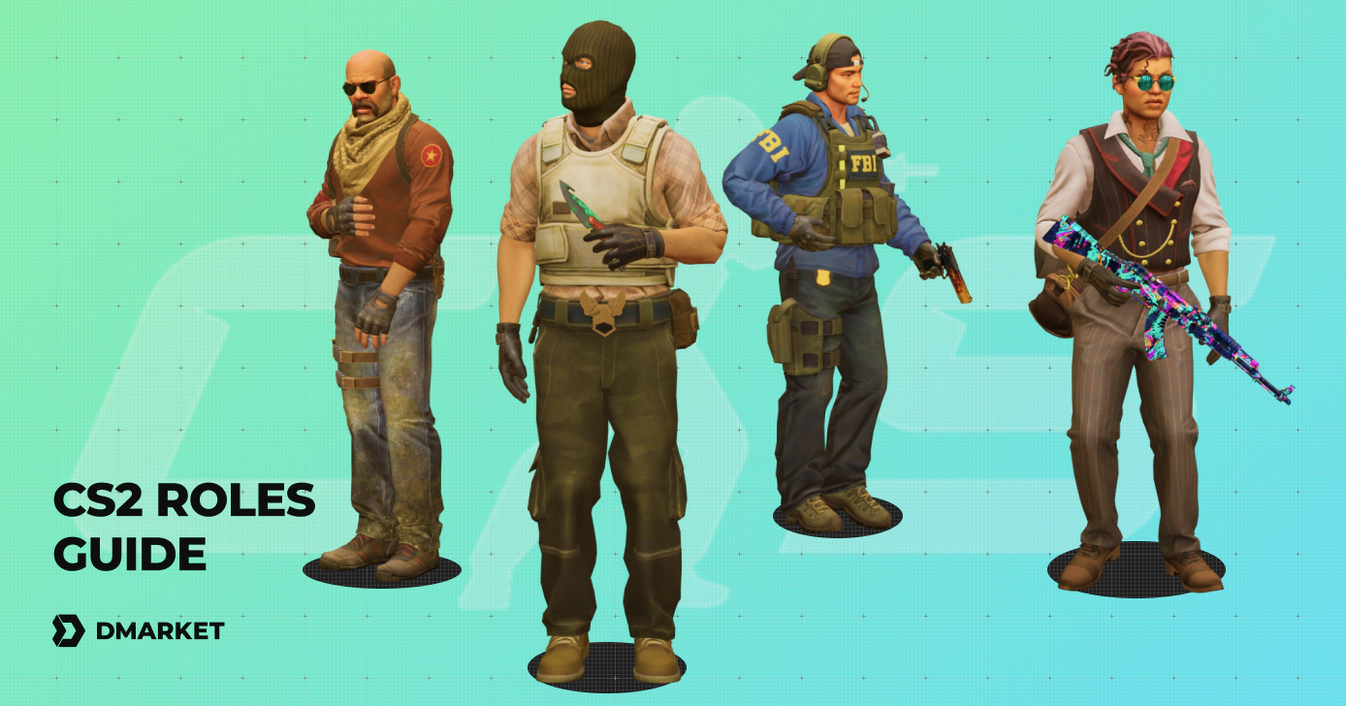
CS2 Roles and Positions Guide
Most players start their Counter-Strike experience quite chaotically. It’s a shoot-and-run game for many beginners. After diving deeper into the tactical aspects, it becomes obvious that success here comes not only from individual play but also from well-coordinated team actions.
Team roles in CS2 turn a bunch of random gamers into a threatening structure. At some point in your growth as a Counter-Strike player, you should understand these roles and pick one.
What Are Roles in CS2?
Counter-Strike doesn’t assign team roles in matches. In its basic form, the game gathers random people—so they can form a team and coordinate roles on their own.
The competitive community has distinguished a few typical roles for Counter-Strike teams. We can see them at esports events. Settled CS2 teams tend to follow this formula for the best results.
If you are a solo player, you should be able to establish your role in the random online matchmaking. If all teammates do this, the process is easy for everyone.
With no roles assigned by the game, it is a good idea to have experience in other positions. You can switch between them to avoid two Leaders or three AWPers in your team.
Core CS2 Roles
As CS2 teams include five players, there are five specific roles. We describe them in this section.
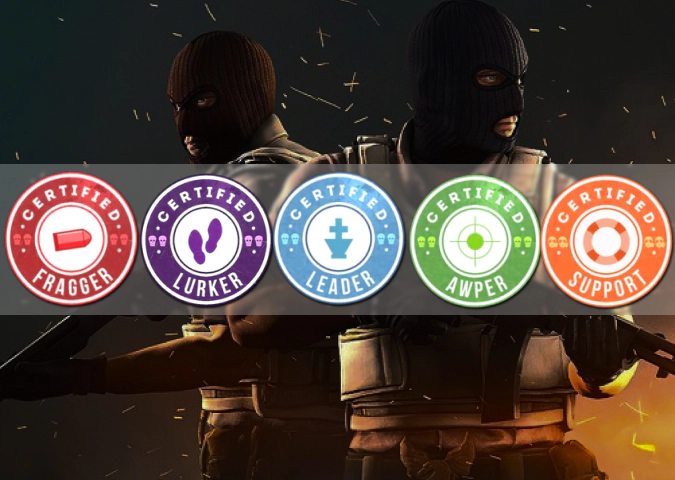
Entry Fragger
It’s a player who enters areas of offense first and delivers opening kills. Entry Fraggers should obtain info on the opponents’ positioning and quickly communicate it to teammates. This CS2 role often applies death after risky pushes. Entry Fraggers create openings for Supports and other players to build further success on.
- Key responsibilities: Enter an area, gather information, and earn opening kills.
- Typical weapons and utility: Assault rifles and smoke. Entry Fraggers often rely on their Support’s utility.
- Required skills: Excellent understanding of typical positioning on CS maps, accuracy with quick shots, and movement control to look around and avoid unnecessary danger. Also, Entry Fraggers should be able to communicate essential info via CS2 callouts.
Support
A Support is like extra power for an Entry Fragger and an AWPer. Such players create the environment for pushes: with smoke and fire. They enter the areas after initial kills or just a bit behind the Fragger. CS2 Supports are often left for clutch attempts.
- Key responsibilities: Use the utility to set the ground for an Entry Fragger and follow them to the area for the main offensive push. Supports may accompany AWPers in the same aspects, which are the initial use of utility and strengthening the advantage with active combat.
- Typical weapons and utility: Assault rifles on full buy and SMGs on force-buy or anti-eco rounds. A good variety of nades is a must-have part of Support’s buys.
- Required skills: Supports should have good knowledge of nade usage, the ability to quickly react to information from Entry Fraggers or to changes in the situation, and be reasonably cautious in combat.
Lurker
Someone who stealthily plays around the map is a Lurker in Counter-Strike. Players in this role follow different goals: create fake calls to confuse opponents, check specific paths and areas to direct teammates, lurk around a defense zone to figure out plans of attackers, or strike from behind to earn an advantage.
- Key responsibilities: Lurkers in CS2 gather and share information as they explore situations on the map. Delivering kills is also a helpful part of their mission.
- Typical weapons and utility: Assault rifles, lower-tier sniper rifles, and SMGs.
- Required skills: Map knowledge, restraint from risky actions, stealthy kills, sharing of info, and quick retreats when needed.
AWPer
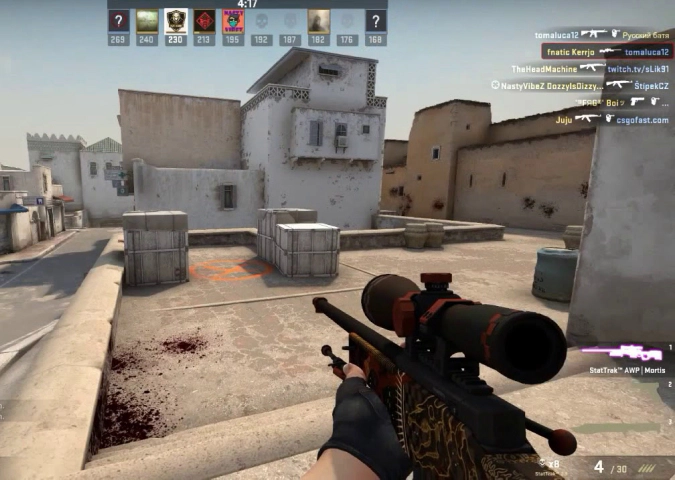
These players carry the most expensive and overpowered guns in Counter-Strike. They are snipers with the AWP. Their goal is to deliver kills from a distance, through tricky angles. AWPers often occupy specific positions to anticipate moves from the opposing team. In defense, AWPers guard the most common approaches.
- Key responsibilities: One-shot sniper kills.
- Typical weapons and utility: The AWP or a lower-tier sniper rifle, updated pistols for close-range combat.
- Required skills: An extremely good knowledge of sniper positions and common long-distance aims. AWPers should be ready to rotate safely, reacting to the info from teammates. Switching between sniper rifles and pistols in the middle of action is also very important.
In-Game Leader (IGL)
Counter-Strike teams need to have one person who makes decisions—on all sorts of aspects. An In-Game Leader does this: what to buy as a team, where to hit on offense, when to rotate, how to react to received info, etc. In terms of action, IGLs take other CS2 team roles, most often becoming an Entry Fragger, Support, or Lurker.
- Key responsibilities: Coordinate the entire team, make economic decisions, encourage and motivate teammates, and bring extra power to other roles.
- Typical weapons and utility: The exact weapon and utility depend on secondary CS2 roles an In-Game Leader decides to play in their team.
- Required skills: Substantial experience in the game and in other roles, excellent communication, charisma to know the right approach to teammates, and versatility of in-game skills.
Roles on T Side vs CT Side
Two teams in Counter-Strike also have their roles, and they can change throughout a round.
- The Terrorist side is mainly attackers, but when the bomb is planted, Ts should play defensively.
- The CT side most often start as defenders. If they lose a bombsite, the remaining players may decide to go offensive to retake it.
With this structure, the team roles in CS2 depend mainly on an in-game situation. Players should be flexible within their current goals.
Entry Fraggers turn into Supports when their team requires defense. Lurkers may abandon their stealth approach when there are few teammates remaining for other actions.
AWPers are sensitive to the economy. If they go to an assault rifle, such as the AK-47 and M4A4, their role also changes. Eco rounds shuffle CS2 roles as well: everyone just runs as a pack.
It is crucial to feel the difference in goals for attacking and defending phases to adjust actions for your chosen role. CTs may even have an extra role, an Anchor: when they need to leave one player on a bombsite.
How to Choose the Right Role
There are three components in selecting a CS2 team role especially for you.
- General preferences: You should like the idea of being an Entry Fragger or an AWPer.
- Natural tendencies: We are all different. Some people are just better at specific roles. Only practice can highlight your strengths.
- Skills and experience are crucial for AWPers and In-Game Leaders. Beginners should start with other roles and then cautiously move to these.
The best approach to choosing the right role for you in CS2 is the following.
- Focus on each in your head and distinguish which you like the most.
- Play this role and judge yourself objectively. Were you good? Was this role really that enjoyable?
- Experiment with other roles. Check if you achieve better results in them.
- After some experience, find a role that unites personal satisfaction and real efficiency in Counter-Strike matches.
The division on CS2 team roles becomes most effective when you play in a settled team. Still, even with random teammates, you can communicate roles and related actions. This approach to Counter-Strike will improve your results.
When you settle with your selected role, adjust your practice accordingly: from training spray patterns for your preferred weapons, to learning positions and passageways typical for your role.
Also, don’t hesitate to be creative. The best players define roles, not follow some strict archetype rules.
FAQ
- Are CS2 roles officially defined by the game?
No, team roles in Counter-Strike are defined by the competitive community. The game doesn’t assign roles for players nor explain them.
- What is the most important role in CS2?
All roles are important. Players should act as a well-coordinated organism, where each element is crucial for success. On the emotional level, pro AWPers often receive the most recognition.
- Which role is best for beginners?
Support is a versatile role for beginners to explore their abilities. You can start from it and then shift to others—to experiment with everything the game has to offer. Entry Fragger is a great starting role for offense-oriented players, to feel an adrenaline rush.
- What does an Entry Fragger do in CS2?
Such players are the first to enter map areas, deliver opening kills, and collect info on opponents. Entry Fraggers break defense, reveal the opponents’ positioning, and create space for their team.
- Can one player play multiple roles?
It’s a common practice in non-professional Counter-Strike. In online matchmaking, you may need to shift between a couple of roles to adapt to random teammates. In settled teams, players stick to their primary roles.
As for changes within one round, they are a common response to in-game situations. Economic factors, the number of alive teammates, and opponents’ actions can be reasons to shift to another role. IGLs should coordinate such adjustments.
- Do roles change between Terrorist and Counter-Terrorist sides?
The roles are the same for both sides. Still, actions can change depending on the current goal: defense or offense.
- How do I know which CS2 role suits me best?
You should generally enjoy what role you play in a team, and then check if your preferences bring practical results. Gain experience in the game and try different roles to clearly feel if you like them or not—and if you are good at them.
Trade on the go - install the mobile app of DMarket from Google Play or App Store. Never miss great prices and unique skins. The best CS2, Dota 2, Rust and TF2 marketplace is always at hand!


Follow us on Facebook and Twitter to get more useful guides about CS2!